In the Manner of Flowers
How to live like a flower...Open, Full, Brilliant, Alive
Flowers have enchanted me throughout my life. I remember wandering through a bed of orange marigolds when I was three or four. The marigold plants were tall and the flowers were lit by the sun, high up above my head. I was 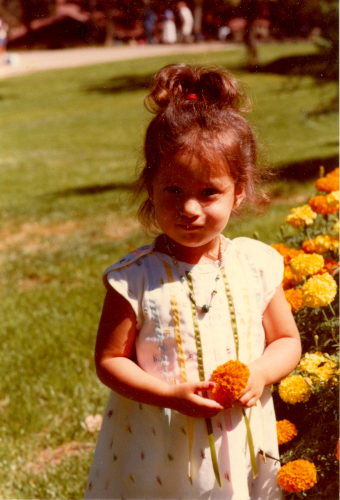 in wonder, without words or thoughts. I observed the many petals of the flowers and the intricate structure that they created. The petals were glowing orange against a background of green leaves. The fragrance of the plants and the earth below them mingled with the glistening of an early morning watering. This is my first memory of my love of flowers, and my easy and immediate connection with them.
Flowers are a natural and happy way for me to bring beauty and love to others. As a child I made flower leis and malas. And I decorated paths and sand rangolis with flowers. When I was a teenager I learned how to arrange flowers. I worked with a cadre of skilled women, making arrangements for the meditation halls, temples, and sacred places at The Mountain of Attention Sanctuary. Some years later I lived at Adi Da Samrajashram, the hermitage sanctuary on the island of Naitauba, in Fiji. There I served my Guru, Adi Da Samraj, in person. One of my responsibilities was to create fresh flower arrangements for His environments. I delighted in serving him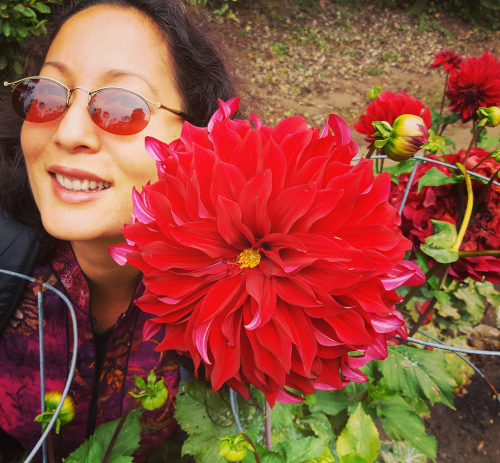 in this way. Much testing, learning, and growth happened during this time. Adi Da commented on my flower arrangements, humorously critiquing my work, and asking me questions about the flowers. There was a lively play between us about flowers. Some years later He told me to further my training in flower arranging. When I returned to the mainland I studied in the Sogetsu school of Ikebana under sensei Shuko Kobayashi. What he taught me transformed my approach to flower arranging. I learned about line, movement, and the sculptural interplay of natural forms. I have continued to practice this art ever since. I am still making flower arrangements for The Mountain of Attention Sanctuary; have been for many years. I have made flower arrangements for special events for my friends and family; flowers for birthdays, weddings, anniversaries, reunions, and funerals. I
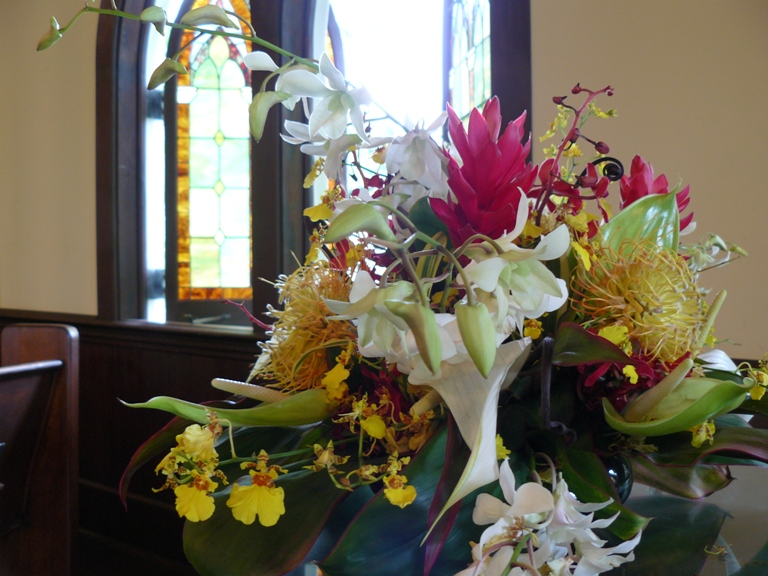 create arrangements for my own living spaces too. I value the continuity of doing it as a daily or weekly practice, it keeps my skills sharp and the inspiration flowing. I always travel with my clippers because I never know when my services may be called on.
One day I was painting while listening to a recording of Adi Da Samraj teaching the Life of Understanding course to a small group of students in Los Angeles in the early 1970s. They would gather at his house in Laurel Canyon and spend the evening listening to him read from and elaborate about The Knee of Listening, his spiritual autobiography. I had a paint brush in hand when I heard Adi Da speaking about the prologue to The Knee of Listening. This is what he said:
The felt quantity and cycle to death has not modified the fragility of flowers, even the flowers within our human body. Examine flowers; examine the delicate structures of the world. If death were what it seems to be, what we assume it to be from the point of view of our willful narcissistic attempt to survive in particular form without change, if it were what we conceive it to be, why wouldn't something as fragile as flowers, for instance, begin to show the effects? Why do flowers continue to manifest---open, full, brilliant, alive, without the quality of contraction, if death were what we think it is? Just so the flowers, the open, living, psychic, subtle life within us has not itself been made obsolete by the endless death that is periodically experienced by all entities. As soon as we turn to these functions in ourselves we see that they are alive, full…completely available. The only thing that suppresses them is, in fact, this notion we have of what life is, what makes life shrink and contract and become obsolete. Life in itself is not modified at all by the quality of death, nor is consciousness, real Consciousness. Therefore our understanding of consciousness and life must be turned to that inclusive quality, that clarity and wisdom, that power and untouchable Gracefulness this evidence suggests…this evidence of the flowers.
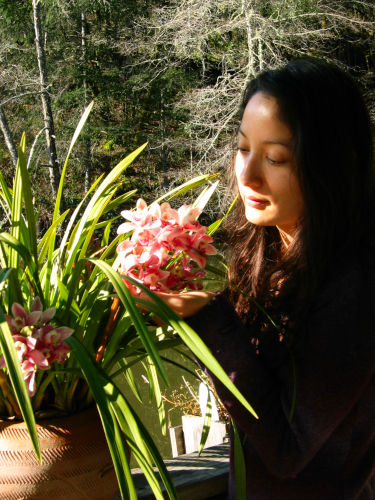 These words spoke to me directly. I was particularly struck by Adi Da’s description of the nature of flowers; they are open, full, brilliant, and alive. They live and die without fear or contraction. They participate in the universal sacrifice of this mortal place, beautiful and full of life. We would be wise to remember, or learn, how to do this too. To live as flowers ourselves…what would it feel like to be open, full, brilliant, and alive all the time? This consideration has stayed with me. It informs me how to feel and breathe each day, and how to love in the midst of all of the difficulties and tests of life. I am reminded to let go of the clench of contraction, to be in a surrendered disposition, and to trust life. After hearing Adi Da’s description of the nature of flowers I knew that I wanted to create a painting celebrating flowers. I opened my mind to design ideas for this painting and ended up doing two different sketches for the piece. I liked both of the drawings and decided to do two paintings.
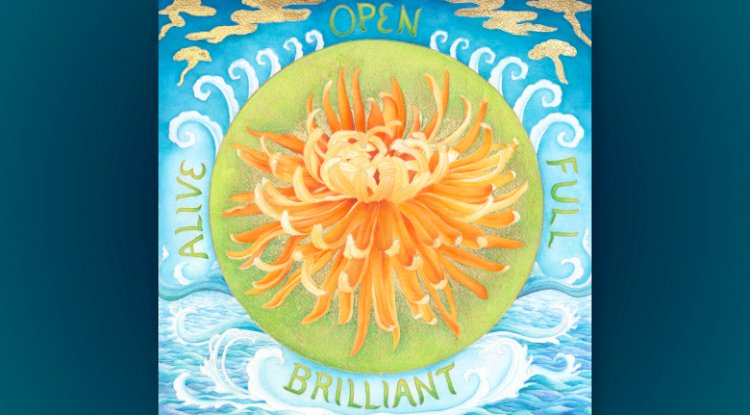
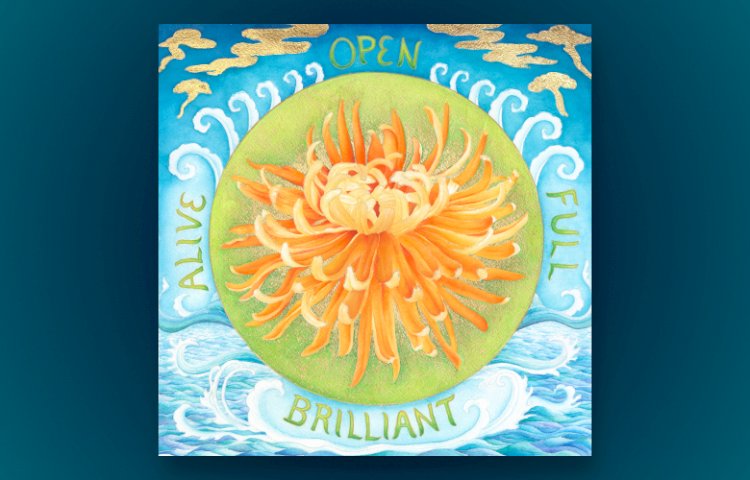
The first painting, which is pictured above, is named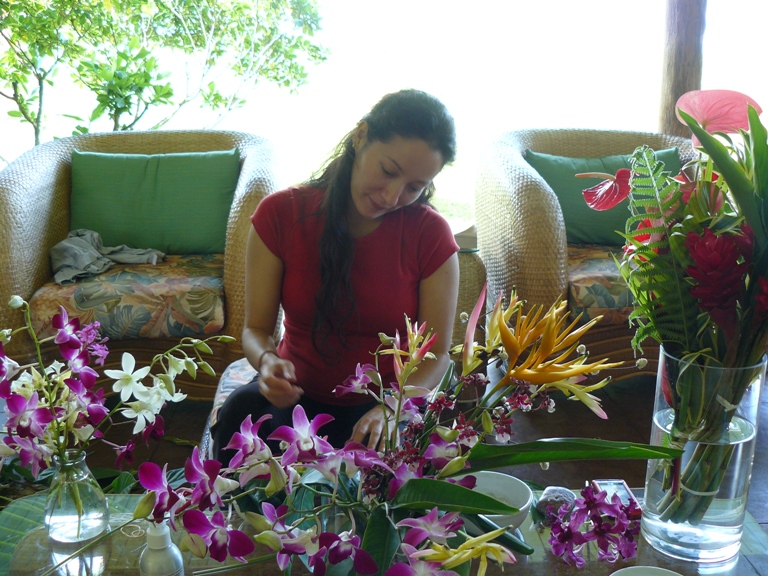 The Manner of Flowers. I chose a chrysanthemum for the central flower. There is a tradition in Japan where people gather together to view a perfect chrysanthemum in bloom. The host gardener invites his guests to view the flower on a full moon night. Everyone spends the evening drinking green tea and marveling over the beauty of the flower. Adi Da Samraj spoke about this tradition and also wrote about it in The Happenine Book. I placed the chrysanthemum flower inside a circle of infinity, a circle inside a square. Lively stylized waves rise up from the bottom of the painting. I wanted the water to be wild and energetic in motion. I also added waves around the top of the circle, they symbolize that same energy moving up and out from above. I added gold leaf clouds to the sky. The words “Open, Full, Brilliant, and Alive” are placed on each side of the image.
The second painting is titled Flower to Infinity. This painting is about stillness instead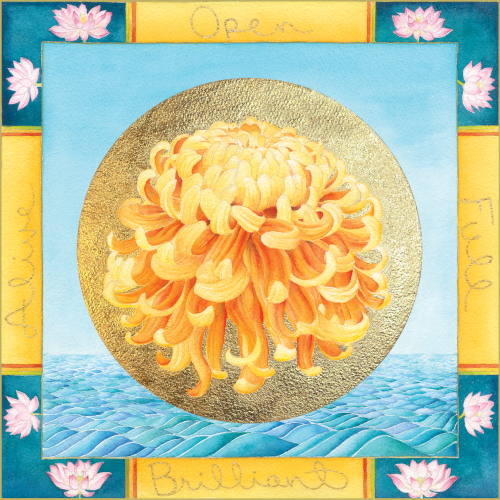 of movement. It is peaceful and balanced, reflecting Consciousness. Again I painted a chrysanthemum and surrounded it with gold leaf. In the light the gold circle flashes brilliantly! I painted a wide open sea below the flower. I painted lotus flowers around the border of the piece. They symbolize awakening, transformation, and rebirth. I painted the words “Open, Full, Brilliant, and Alive” in Adi Da’s handwriting, then applied gold leaf to the letters so that they shine bright when viewing the piece. Both of these paintings drew inspiration from Tibetan thangkas and yantras.
Let us all remember to live as flowers. Let us bring love into life. Let us forget our fear and unhappiness and hold on to nothing. May we remember the unity that we are a part of. May we cooperate with one another. May we exercise the flower to infinity.
Here is the text of the original prologue to The Knee of Listening, titled “Heart of Understanding”:
Death is utterly acceptable to consciousness and life. There has been endless time of numberless deaths, but neither consciousness nor life has ceased to arise. The felt quantity and cycle to death has not modified the fragility of flowers, even the flowers within our human body. Therefore, our understanding of consciousness and life must be turned to that utter, inclusive quality, that clarity and wisdom, that power and untouchable gracefulness this evidence suggests. We must cease to live in our superficial and divided way, seeking and demanding only consciousness and life in the present form that we grasp, avoiding and resisting what appears to be the end of consciousness and life in death.
The Heart is that understanding, that true consciousness, that true life that is under the extreme conditions of life and death. Therefore, it is said, that One that is neither born nor come to death, not alive as the limitation of form, not rendered in what appears, and yet it is the living One, than which there is no other, appearing as all of this, but eternally the same.
There is only the constant knowledge and enjoyment of the Heart, moment to moment, through the instant of all conditions of appearance and disappearance. Of this I am perfectly certain. I am That.
What's Your Reaction?